Thursday, January 20, 2011

Mr. Darcy, Complete Bore

I think I've read my first and last modern adaptation of a Jane Austen work, Mr. Darcy, Vampyre. I picked it up for the most shallow reasons possible:  I love Pride and Prejudice and I love vampires. As I have seen with Sense and Sensibility and Sea Monsters and Android Karenina some mashups of old concepts with modern twists are not meant to happen.


austenprose.com
 I have so many complaints about this audio book, but this biggest one being that, it's boring. I found it very charming as Grange wrote a simplistic double wedding for Lizzie and Jane to Darcy and Bingley, respectively. In fact, I could picture in my head the sunlight streaming through the church windows, and I thought to myself, "Why isn't Darcy bursting into flames?". Once the wedding is over Elizabeth and company go on their wedding tour which takes them all over Europe visiting Darcy's VAMPIRE socialite friends, including a famous count who lives alone in a large castle, has villagers storm said castle occasionally, and cannot cast a reflection. I WONDER WHO THAT COULD BE?!

From here there are long arduous paragraphs about traveling, what the Darcys ate and how lonely Elizabeth feels because Darcy won't take her to bed and make her his wife. There is absolutely zero tension apart from an odd middle section where Darcy defeats an evil vampire of unknown origin whose mission is to BED EVERY
VAMPIRE BRIDE EVER MADE. Of course this would not do for Darcy so he comes to Elizabeth's rescue. Might I add that this "evil" vampire had made only two appearances before the final confrontation and did not pose a threat in any way that Darcy did not dispatch with a quick cane slap to the canines. BAD evil vampire! Naughty, wicked, bad villain!

The story concludes with a convenient quick and easy way for Darcy to dispatch himself of the vampire curse (SPOILERS:::: ****** true love and water******), for him to defeat the evil vampire dark lord, dispatch all the haughty socialite friends who disapprove of Elizabeth, bed his wife and return to England for more grand adventures filled with LOOOOOOOVE! Grange doesn't even add anything new to the vampire mythology except for the fact that love can defeat a vampire by giving him third degree burns to the face, vampirism can be cured, and vampire covens each have a unique thing that can harm them (crosses, garlic, sunlight) but never more than one. Nothing original is put into this adaptation, as I had hoped for.

Granted I did find the idea of Mr. Darcy as a seductive, brooding, Snape-ish if you will, vampire attractive. But...nothing happens in the novel! They go on tedious trips with tedious descriptions and meet tedious vampires and will probably go on to have boring children.

Verdict: Do not pick up. It's boring. Snooze fest. Stay away.

Try this instead, Vampire Darcy's Desire. I have no wish to repeat my experience with Amanda Grange but now I feel like I have to pick up this book out of morbid curiosity to see how well, or how badly they treat the vampire trope.

http://www.amazon.com/Vampire-Darcys-Desire-Prejudice-Adaptation/dp/1569757313

"Tormented by a 200-year-old curse and his fate as a half-human/half-vampire dhampir, Mr. Darcy vows to live forever alone rather than inflict the horrors of life as a vampire on an innocent wife. But when he comes to Netherfield Park, he meets the captivating Elizabeth Bennet. As a man, Darcy yearns for Elizabeth, but as a vampire, he is also driven to possess her. Uncontrollably drawn to each other, they are forced to confront a "pride and prejudice" never before imagined--while wrestling with the seductive power of forbidden love. Meanwhile, dark forces are at work all around them. Most ominous is the threat from George Wickham, the purveyor of the curse, a demon who vows to destroy each generation of Darcys."

Thursday, January 6, 2011

The Adventures of Huckleberry F(#$

If you haven't already heard about this more recent explosion over the library blogosphere then I am very happy to report it to you, because it is a very tragic situation.

According to an article from USA Today, Huck Finn and Tom Sawyer (those rascally fictional characters from beloved author Mark Twain) are getting an upgrade for modern readers:

"Mark Twain scholar Alan Gribben is causing a controversy by publishing the combined works of the 'Adventures of Huckleberry Finn' and 'Tom Sawyer" that features the N-word replaced by "slave" in an effort not to offend readers."

To elaborate, Gribben's reasons for this decision stem not from upsetting other Twain scholars, but from attempts to reach the audience (high school children and anti-racists) who will not grant access to the book or pick it up themselves because of its offensive content.

""When the younger reader is staring at that word five times on a given page and the instructor is saying, 'Mark Twain didn't mean this and you have to read it with an appreciation of irony,' you're asking a lot of a younger reader," Gribben says."

I have so much to say about this, such as is it at the teacher or the school board's discretion to make this required reading for high schoolers? Are students this age mature enough to handle the satirical implications and historical references behind the "n" word? I don't even know where to begin.

The head of the Office for Intellectual Freedom hits the nail on the head with how I feel about this action:

"The book without that word is not Huckleberry Finn," says Jones, head of the library association's Office for Intellectual Freedom. Twain "put it there because he wanted people to struggle with it. I think, as a country, we're big enough to struggle with it."

The point I wish  to make about actions like this is this:  scholars can call it whatever they want, they can make up 100 reasons why removing original material from a novel in order to "help it go down easier" or "make it more accessible to younger readers" is an appropriate course of action, but I'm going to come out and say what's really going on here:


That is all.

Sunday, November 14, 2010

Falling - Deine Lakaien, I'm Hungry Like the Wolf - Duran Duran

In which I write my thoughts on Lauren Kate's Fallen, specifically the audio book:

Audio Length: 10 hours and 59 min.,
Release Date: 11/12/2009
Narrator: Justine Eyre
Format: Unabridged

** spoiler alert ** This book really surprised me with its plot and intrigue. I was afraid to pick it up after putting down Hush Hush because I couldn't take "yet another teen angst love triangle involving the Supernatural....AGAIN". I have a guilty pleasure for boarding school novels and this one does not disappoint. I do get a little disappointed at how much Luce loses herself in her infatuation for Daniel and how much she comes to depend on him. Frankly she becomes a fairly incompetent character who is left in the dark on most of the plot points, as is the reader. Lauren Kate definitely leaves the ending open to a trilogy and I now want to finish the series to see how it ends. And I know this is getting nit picky but fail on Lauren Kate's part for making the librarian a villain. I loved the secondary characters including Daniel's arch nemesis and the "dark to his light" so to speak, Cam, and Luce's fast friend who reminds me of a fairy raver friend of mine, Ariadne.
 
I do love when I catch mistakes in audio books, they always make me chuckle.I recall when I was listening to the audio book of Libba Bray's Rebel Angels I heard the author stop reading and say to herself how she was going to re-read the character's last sentence in a more convincing manner, i.e. less warbling. In the case of this audio book it was less obvious. The narrator has chosen one way to pronounce a character's name and then a few chapters later completely pronounced it in a different way...twice. 
 
The next book in the series is Torment, where Luce is transported to another boarding school where she learns more about her past lives and begins to distrust that her beloved, Daniel is telling her the whole truth.
 
I've had a good experience reading Maggie Stiefvater's "The Wolves of Mercy Falls" series. The love between Sam and Grace is loving without being too  lovesick. Their comfortableness with one another puts the reader at ease and makes them invested in their star crossed lovers plot. The two also read to each other in a corner bookstore loft, which to me is the ideal romantic situation. I may end up buying them. The visceral description of werewolves in winter makes it a good December read. I have yet to catch up with the final book, Forever.
 
Now that I'm on the subject, what's the deal with authors mass producing trilogy series? Are they following in the footsteps of author before them where a trilogy means not only an extended plot but more fans, more money, and more book tours? Or did they originally have a novel length story to tell that they just broke up into three books? The other series that I can't to finish is another supernatural love triangle involving Carrie Jones' pixies.
 
[images courtesy of goodreads]

Oh...and just for the heck of it, here are links to the songs referenced in the title:

For Falling - Deine Lakaien
For Hungry Like the Wolf - Duran Duran

Friday, October 29, 2010

Very short post on Imagination land

I've always been curious about this since it's different for everyone, but I wanted to pose the question anyway:

How do you read?

Ok so that wasn't a very clear question, what I mean is how do you bring characters and events to life as you're reading a book with no pictures? For me I can describe the process as I'm playing that scene or that character's conversation in the space behind my eyelids (possibly my brain). One would wonder though how I can pay attention to moving pictures while simultaneously reading letter (R - L or L - R) across a page? I don't know. It's a myestery. So I ask again, how do you read?

Also, say a character is introduced into the book with a minimalistic description (gender or skin color). Do you impose a certain race or other descriptive qualities to the character? For example, I'm currently reading the middle book, Linger, in Maggie Stiefvater's Werewolf Sam & grace trilogy (preceded by Shiver). While the main character, Sam, has been described with moppy dark hair and golden eyes my mind immediately pictured him and Grace to be a matched pair of blondes and this is how they stayed.

Image courtesy of arockridgelife.wordpress.com
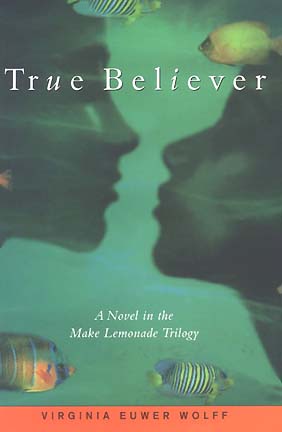
While some authors take time to introduce a character's attributes and description, some authors such as When you Reach Me 's Rebecca Stead and Virginia Euwer Wolff's Make Lemondae Trilogy only provide one attribute, such as skin color, or none at all to be purposefully ambiguous. As a result, readers may try to "place a race" on the character, either for imagination or for curiousity's sake. I know I've read that Wolff purposely left her main character's race to be ambiguous because she didn't want it to control the transformation of her character (minority rags to riches story, if that makes sense). Readers made inferences anyway based on such details in the book as geographic location, dialect, etc. How do you feel about this practice in young adult and children's books? Does assigning a race to a character ultimately bring up particular stereotypes embedded in the reader's brain, much as my mind takes control over how a character physically appears despite what the author writes?

In the School Library Journal blog, I found an article entited, "When You Reach Me: The Race Card" that touches more on this subject:

"JULIA’S AMBIGUOUS RACIAL IDENTY

Julia’s skin color is described, but she’s never labeled racially or ethnically. She could be African American, but she could be Indian or Asian, too. Or biracial. As I mentioned earlier, it’s a similar technique employed by Virginia Euwer Wolf in the MAKE LEMONADE trilogy. It allows the reader to impose an ethnicity or racial identity on the character. We would generally recognize this as a strength, but there’s also a trade-off. Isn’t there also a generic quality to the character? One writer told me that, for example, when you set a book in the South, everybody knows that it’s hot and humid. What she looks for are the details in the setting that reveal a native understanding of the region. What are the details that would escape the notice of the casual visitor? Apply this to Julia’s characterization. She’s universal, but not very specific. Again, this is not a weakness of the book, generally speaking or in terms of the Newbery criteria, but it still left me wishing for those extra skillfully woven details. Another slight note of dissatisfaction."

I guess a point to take away from this discussion is that steroetypes have the ability to be changed or destroyed. So if we're dealing in the realm of fiction and not fantasy (where races are optional and as changeable as a pair of jeans), perhaps we can take comfort in this fact that even the reader's stereotypes of particular characters can be changed through reading books such as Stead's and Wollf's.


Wednesday, October 20, 2010

In the fictionalized world of Jane Austen

I've developed a Jane Austen fictionization (fixation + fiction) ever since I rewatched "Becoming Jane" with my roommate. This was exacerbated by my discovery of Just Jane: a Novel of Jane Austen's Life by Nancy Moser. This fictionalized account is one of Moser's many fictionalized biographies of historical women. The book picks up after Austen's disastrous romance with Tom Lefroy (those of you who have seen "Becoming Jane" will be brought up to speed). If you're more interested in that portion of Austen's life (and at some parts of this book, I certainly was,) I would bypass Moser altogether. If you're more interested in hearing how Austen used her life experience to become a world famous writer, then I highly recommend you pick this up. While Moser does her research well to accurately portray events in Austen's life, the majority of the book is inflated with fictionalized accounts connecting events and people described in letters and other accounts of Austen's life. The story could even be read in a series of vignettes concerning events (boring and riveting) that make up the life of Jane Austen including engagements, death, illness, social visits, and relocating all over England. The plight of Austen throughout this novel is her conflict with rising above society's expectations for her to marry and bear children in order to be less of a burden to her family in order to become a pubished author. Jane often becomes bored with the monotony of her life and the only time she is happy is when she's writing or discussing her writing with friends. If you're not familiar with Jane Austen's novels this will not hinder your understanding of Just Jane.

Some downsides to the vignettes are that while some are invigorating, others drag, and the time jumps are only reflected by Jane remarking about how much older she has become. The way the book is written, the events seems as if they could be happening within a span of a few weeks. But the reader must remember how often letters took to arrive anywhere considering the mode of transportation at the time (horse, carriage, or foot). The upside is learning about Austen's thought and writing process and her difficulties with finding inspiration. The writing comes off very solid for a fictionalization. Jane Austen's voice remains true though I did catch some instances of modern slang.

On the whole, I give it a rating of 3 out of 5. I definitely will be gifting this to a friend of mine who I know would enjoy it. Reading this has also made me want to pick up "Emma" as I'm already familiar with Pride and Prejudice and Sense and Sensibility.

Review: http://www.curledup.com/justjane.htm

Monday, October 18, 2010

Conclusion to the Vampire Saga: Vampires are Stalkers

I now present to you the last book I wrote about for my Young Adult Literature class back in the Summer of 2009. I began these posts back in August of 2010 and covered the various adolscent paradigms represented within young adult vampire literature (that ISN'T Twilight) published between 1991 and 1997. I'll relist them here.

Anderson, M. T. Thirsty. United States: Candlewick Press, 1997.

Atwater-Rhodes, Amelia. Shattered Mirror. New York: Delacorte Press, 2001.

Hauptman, Pete. Sweetblood. New York: Simon Pulse, 2003.

Marrona, Amanda. Uninvited. New York: Simon Pulse, 2007.

Rees, Douglas.Vampire High. New York: Delacorte Press, 2003.

Smith, L. J. The Vampire Diaries: The Awakening. New York:  Harcourt Press, 1991.

Of these titles, Smith's The Vampire Diaries, Atwater-Rhodes, and Rees have continuing books or have created a series around the books. The Vampire Diaries wins hands down for being the most popular series and most promoted within streams of social media. This is amplified and aided by the revamp (ouch) of the series due to fan demand, in which L. J. created another trilogy of books called "The Return". From this stemmed the TV show, "The Vampire Diaries" which is currently in its second season. By far these aren't the worst titles you can find amongst vampire young adult literature today and they all make valid points about the mythology that are both varied and unique. Throw in  a few psychological aspects such as vampirism as an allegory for adolescence and puberty, and you have a way for teens to relate to the material. I hope that you add these to your reading lists or recommend more vampire literature novels that teens (or myself) might like. I leave you, just a week or so before Halloween, with the final installment of the paper, Uninvited, which tells the story of Jordan and her recently dead boyfriend, Michael Green, who begins to exude stalker-like tendencies from beyond the grave.

                          Marrone, Amanda. Uninvited. New York:  Simon Pulse, 2007.

Jordan’s boyfriend Michael Green is the greatest thing to ever happen to her. The most popular new boy in school not only relieves her social anxiety, but also makes her feel that she matters and is loved. Unfortunately, the prospect of facing the entire student body with Michael on her arm is too much pressure for Jordan to handle, and she breaks up with him. Shortly thereafter, Michael Green is found dead and is rumored to have committed suicide. As Jordan copes with this loss through alcohol and drugs, Michael begins appearing at her bedroom window every night begging to be let in so they can be reunited. As his visits become more frequent and intense Jordan begins to suspect that her ex-boyfriend is not dead, but undead.
Uninvited is the best example of the renegotiation of power developmental task. Michael’s visits demonstrate immense power over Jordan by confining her to her bedroom. Readers should recognize the signs of stalking and abuse through Michael’s behavior: keeping Jordan constantly afraid to see her friends, meet new people, or venture out after sunset. At first, instead of confronting Michael, Jordan abuses drugs and alcohol as a means of denial and escape. However, Marrone highlights Jordan’s small victories like keeping Michael outside her window and emphasizes her transformation from victim to heroine when Michael threatens her best friend, Lisa. Ultimately, Jordan is a flawed yet appealing protagonist since she overcomes Michael’s controlling behavior, becomes sober, creates healthy relationships, and moves on.

In Uninvited, vampirism is a metaphor for suicide as well as avoiding conflicts. Both Jordan and her friend Lisa consider using vampirism to escape their problems: Jordan’s lack of self-esteem and parental guidance via absent parents and Lisa’s diagnosis of lupus. Because of the various references to unsafe sex, drug and alcohol abuse, attempted suicide, and other serious issues this book is appropriate for high school readers.


Friday, October 15, 2010

Vampires in High School Part V: Vampires are Closet Diabetics

Since I do want to try and wrap up this review of YA vampire literature in time for Halloween I'll go ahead and shuffle on in a zombie like fashion onto the fifth book of my paper, Pete Hauptman's Sweetblood. Fang you for your patience.

Hauptman, Pete. Sweetblood. New York: Simon Pulse, 2003.

16-year-old Lucinda Szabo has several identities: she is neither Goth, nor punk, but something. To her parents and teachers she is Lucy, to her friend Matt she is Skeeter, and to the online Transylvania chat room she frequently roams looking for “real” vampires she is known as Sweetblood. The catalyst of Lucy’s search for “a real vampire” is a paper she writes for class explaining her theory that vampires are actually diabetics suffering from a dangerous lack of insulin. As her search progresses, Lucy becomes less focused on school and her diabetes and more focused on exploring the vampire culture in her neighborhood which is filled with geographical references to Dracula: Seward High, Harker College, and Carfax Apartments.

Sweetblood is appropriate for middle and high school readers as there is very little sexuality but some instances of underage drinking. The presence of vampires here is more metaphorical and theoretical than fantastical. Outside the Transylvania chat room Lucy meets Wayne, who enjoys the guise of a vampire but does not believe they exist. Several of Lucy’s friends also participate in the goth culture but the book never reveals anyone to be a vampire.

Teens will relate to Lucy’s character who is not only trying to establish an identity for herself. Her screen name is significant because it defines her fascination with vampires and her diabetes, both important aspects of her identity. Lucy is a relatable character because she makes very immature decisions throughout the book that endanger her health and have serious consequences. In addition, Lucy’s rebellious attitude towards concerned adult figures such as her teachers, parents, and psychologist is readily identifiable to young adults. Hauptman’s metaphor for learning and growing during adolescence is portrayed through a monarch butterfly chrysalis which is given to Lucy her love interest, Dylan. Sweetblood is very character driven and relies on the interactions between the characters to show that Lucy is not alone as she believes she is.