Showing posts with label children's literature. Show all posts

Thursday, July 14, 2011

A Feast of Crows

Tony, a co-worker who is also filed under the heading of my last entry "serendipitous meetings" [more on this later] inspired me to write about Aldous Huxley's children's book The Crows of Pearblossom. Huxley wrote this story for his niece in 1944. This is a very interesting book since it was not only penned by the famous author of A Brave New World but also because of its illustrations.

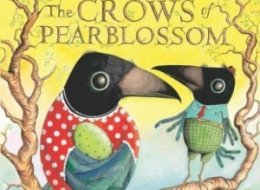
The Crows of Pearblossom, illustrated by Sophie Blackall, tells the tale of two crows who nest in a cottonwood tree at Pearblossom, with a tenant, Rattlesnake, living below them. This tenancy causes some issue when Rattlesnake comes up to the crows' nest every day and eats however many eggs she hatches that day. Distraught, and accusing her husband of being insensitive to her plight of losing her children, Mrs. Crow (Amelia) suggests that her husband, (Abraham) kill the snake. We he retorts, "Somehow, I don't feel that's a very good idea . . . Your ideas are seldom good," Mrs. Crow angrily tosses the accusation that her husband is afraid. Adamantly he claims is he not and goes to his friend owl in search of an idea to take care of the snake. Together they concoct a scheme of baking two clay eggs and using them as decoys for the snake. Their plan is successful despite Mrs. Crow's misgivings about not killing the snake. Once Mr. Rattlesnake realizes his mistake he so tightly wound around tree branches to help ease his tummyache that he cannot unwind himself. Mrs. Crow proceeds to give him "a very long lecture on the wickedness of eating other people's eggs". There is a happy ending to the tale with Mrs. Crow's abundant brood providing enough diapers that she puts the snake to use as a clothesline to dry them on.

My first instinct with this book that I didn't like it, despite Tony's enthusiasm. I have several reasons for this:

Context: The story itself is dark and filled with the husband and wife insulting each other, bickering crows if you will at every turn, "Abraham, you talk too much. Keep your beak shut and do exactly what I do."/ "Amelia, you talk too much. Keep your beak shut and get out of your nest." The language of the book in this instance is very negative. Also, the vocabulary of the book is very far advanced for the K-3 group, "wickedness", "negelected", "impatient", "vile", "irrigated", etc. Thirdly, there are hidden jokes and adult (not mature) content within the book that the children' won't pick up on. For example, Mr. Crow is portrayed to be a slight crow with striped pants, tiny glasses, and pocket protector, for his job as "assistant manager at the pharmacy" (I'm quoting directly from the book here). And Mr. Owl apologizes to Mr. Crow when he comes to visit because he works the night shift and is in his bedroom slippers. You can ascertain from this fact owls are nocturnal but I don't believe most kindergartenders would pick up on it. I could go on to say what when Mr. Owl and Mr. Crow come to visit Mrs. Crow she is in bed and her hair is in rollers and  Rattlesnake who lives downstairs has argyle socks under his bed and dentures in a cup on his bedside table, implying that he is old. Overall they add a very sardonic humor to the story, especially when coupled with the language but I don't think it's very translatable to this age group that the book is aiming for.

Art: The artwork is brilling on some pages while falling flat on others. On one page Blackall has Mr. Owl and Mr. Crow standing over the chimney waiting for the clay eggs to bake. The entire text of the page is filled within a speech bubble made up with smoke from the chimney. Blackall also does some amazing contrasts with colors such as black and yellow to make the crows stand out. They're drawn with toucan shaped heads and a beady black eye sticking out. Not very kid friendly if you ask me. Furthermore, most of the illustrations use very dull colors and aren't very eye catching for young children.

Overall The Crows of Pearblossom would make a very good art book on someone's coffee table right up there with The Gashcumbly Tinies, but I don't see this book being read very much except by older readers with a very unique sense of humor.

Library Journal does the book justice I think with their review, which you can find here.

[pictures taken from http://blommi.com/the-crows-of-pearblossom-childrens-picture-book-review/]

Friday, October 29, 2010

Very short post on Imagination land

I've always been curious about this since it's different for everyone, but I wanted to pose the question anyway:

How do you read?

Ok so that wasn't a very clear question, what I mean is how do you bring characters and events to life as you're reading a book with no pictures? For me I can describe the process as I'm playing that scene or that character's conversation in the space behind my eyelids (possibly my brain). One would wonder though how I can pay attention to moving pictures while simultaneously reading letter (R - L or L - R) across a page? I don't know. It's a myestery. So I ask again, how do you read?

Also, say a character is introduced into the book with a minimalistic description (gender or skin color). Do you impose a certain race or other descriptive qualities to the character? For example, I'm currently reading the middle book, Linger, in Maggie Stiefvater's Werewolf Sam & grace trilogy (preceded by Shiver). While the main character, Sam, has been described with moppy dark hair and golden eyes my mind immediately pictured him and Grace to be a matched pair of blondes and this is how they stayed.

Image courtesy of arockridgelife.wordpress.com
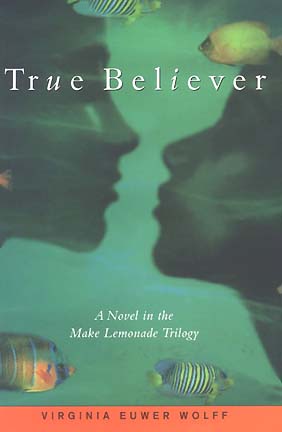
While some authors take time to introduce a character's attributes and description, some authors such as When you Reach Me 's Rebecca Stead and Virginia Euwer Wolff's Make Lemondae Trilogy only provide one attribute, such as skin color, or none at all to be purposefully ambiguous. As a result, readers may try to "place a race" on the character, either for imagination or for curiousity's sake. I know I've read that Wolff purposely left her main character's race to be ambiguous because she didn't want it to control the transformation of her character (minority rags to riches story, if that makes sense). Readers made inferences anyway based on such details in the book as geographic location, dialect, etc. How do you feel about this practice in young adult and children's books? Does assigning a race to a character ultimately bring up particular stereotypes embedded in the reader's brain, much as my mind takes control over how a character physically appears despite what the author writes?

In the School Library Journal blog, I found an article entited, "When You Reach Me: The Race Card" that touches more on this subject:

"JULIA’S AMBIGUOUS RACIAL IDENTY

Julia’s skin color is described, but she’s never labeled racially or ethnically. She could be African American, but she could be Indian or Asian, too. Or biracial. As I mentioned earlier, it’s a similar technique employed by Virginia Euwer Wolf in the MAKE LEMONADE trilogy. It allows the reader to impose an ethnicity or racial identity on the character. We would generally recognize this as a strength, but there’s also a trade-off. Isn’t there also a generic quality to the character? One writer told me that, for example, when you set a book in the South, everybody knows that it’s hot and humid. What she looks for are the details in the setting that reveal a native understanding of the region. What are the details that would escape the notice of the casual visitor? Apply this to Julia’s characterization. She’s universal, but not very specific. Again, this is not a weakness of the book, generally speaking or in terms of the Newbery criteria, but it still left me wishing for those extra skillfully woven details. Another slight note of dissatisfaction."

I guess a point to take away from this discussion is that steroetypes have the ability to be changed or destroyed. So if we're dealing in the realm of fiction and not fantasy (where races are optional and as changeable as a pair of jeans), perhaps we can take comfort in this fact that even the reader's stereotypes of particular characters can be changed through reading books such as Stead's and Wollf's.


Wednesday, June 30, 2010

ALA Day #1

I was very excited and anxious at the same time at the thought of attending my first professional conference for the American Librarian Association. I described it to friends who asked me what I was doing, "What's the ALA Conference?" It's where hundreds of librarians and awesome bibliophiles descend on DC to talk about books and wreak advocacy havoc. Well, maybe not that last part, but definitely a lot of cool and awe inspiring people converging into one place. A few people I spoke to said, "I hear those conference can get pretty crazy." This made me flash back to an invitation I'd received to go to the ALA Dance Party which was Prince themed. All I did was nod and smile in response. Unfortunately, I did not get to attend the Thursday, Friday, or Saturday events of the conference as I had agreed to be in a friend's wedding. This was also before I knew the dates of ALA and could not back out of the wedding as a result without causing offense. So as we begin, my launch date for the conference was Sunday, June 27th at 10:30 am.

I had planned on attending various events starting at 8 am. I was surprised with a visit from long time friends from Leesburg and that turned into late night conversations, bad science fiction, and chips and salsa until 2 in the morning. When I left the apartment at 8:30 am I made it into the conference, registered and breathlessly stumbled into my first event with the ALSC (Association of Library Services to Children), Celebrating the Spoken Word with Poetry for Young People, a program which discusses and sings the praises of using poetry to impact children and literacy. The speakers included Mary Ann Hoberman, Children's Poet Laureate; Stephen Young, Program Director, Poetry Foundation, Poetry Out Loud National Recitation Contest; Sylvia Vardell, Professor, Texas Woman's University, School of Library and Information Science. I recall the youngest speaker, Amber Rose Johnson, most vividly. She was the winner of the 2010 Poetry Out Loud Winner, and is a senior at at a high school in Providence, Rhode Island. The Recitation Contest involved the student picking and memorizing three poems of their choice and then delivering them in front of a panel of judges. I recall her second poem choice, Shakespeare's Sonnet 116, in honor of her parents and Margaret Walker's For My People. She recited the last poem for us and to hear her speak moved the entire room into a stunned silence. It's almost as if we weren't listening to poetry but rather the dreams and hopes of a young black woman speaking of the struggles of African Americans over the past few centuries.

Some of my takeaways from this event about poetry were:
  • "Rhymers will be readers" = Literacy --> Poems --> Children --> READ.
  • We should be looking at what poems do and how they use language when using them with children.
  • The best poetry informs all of our senses.
  • Having kids read poetry along with you, even if they're ESL kids and can only focus on one word, is a great way to get them to participate and into poetry
  • Children who have at least 4 nursery rhymes memorized will be reading at higher grade levels by the time they reach elementary school.
  • As quoted by the Amber Johnson, "A poem is a reflection of you, who you are, a reflection of the author, and a reflection of yourself."
I was volunteering at this event for the ALSC and helped hand out handouts (which disappeared faster than you can say, "Free food in the exhibit hall!") Once the handouts ran out I struck up a conversation with a woman volunteering at the event too, a librarian from Montgomery County. I was excited to find a kindred spirit and proceeded to ask her question about working with children in library services. I was disappointed when I came to find that she's looking to change careers because, as she put it, "She's tired of working with children and tired of all the bureaucracy she has to put up with." She's not even a member of ALA she told me. I met with my friend Miranda after this who told me she couldn't stand how negative people were being and usually tuned them out when they spoke like this. I can't tell what my path as a librarian is going to put me through, but I hope not to come out of it jaded and worn.

I accompanied this librarian into the overwhelmingly crowded exhibit hall where we proceeded to chat. I told her I'd ran into the same man 4 times on the metro and throughout my morning at the conference:
"Have you played 'Cite the Librarian' Game?", she asked me.
"What's that?", I asked.
She replied, "Where you look at someone and ask yourself if they're a librarian or not."
"He definitely doesn't look like a librarian," I said.
"You don't look like a librarian either," she retorted.

This comment actually stung to hear. Especially when it was followed by one of the vendors asking me what high school I was from. My attire didn't make me look that young I hope. I had my hair down and undone so that may have been why. My confidence was boosted by a homeless man later on the metro who asked me if I was a librarian or a teacher. He loved us so much, he said, that he eventually wanted to marry a librarian.

Once the librarian and I parted ways on the exhibit floor I spent the rest of the day picking up swag and running into Laurie Halse Andersen, famous young adult author of Speak, Wintergirls, Twisted, Prom, and Chains. I ran into her at her mini Q&A at the Live at your Library Stage. She read an excerpt from her new book Forge which is a continuation of the storyline from Chains following a pair of young African American teens during the Revolutionary War. I clapped softly after her reading and she whipped her head around to me and said, "Don't clap! It's only the prologue. You don't know if the rest is going to be good or if it will suck." She was smiling when she said this though. A very humble writer, Laurie also shared that, "These books are not copy-edited, please don't hate me. I really don't know where commas go." As a gift to herself she has promised that once she finishes her three books surrounding this topic she will read M. T. Anderson's (no relation) similar books beginning with, The Astonishing Life of Ocatavian Nothing.

Laurie tweeted a photo of us at her reading. See if you can find me! It's hard, trust me!

After Laurie's Q&A I spent a lot of time wandering the exhibit hall where I picked up various amounts of swag. I will detail everything I picked up later in Day 3 but suffice to say I scored a gem finding a recorded book narrated by James Marsters for FREE! I also visited Alliance Entertainment booth who were GIVING AWAY FREE CDs and cleaned them out. I think I walked away with maybe 10 or 12 CDs total of popular and eclectic music. Best find ever was Massive Attack's latest album.

My second volunteer program for ALSC was called "Good Comics for Kids" which was a panel of librarians, most of whom were dressed in steampunk attire, recommending good graphic novels for kids up to middle school. I met Erin Burns here, a library associate from DC Public Library, and she gave me insightful advice on how to survive searching for a job. She had been unemployed for 8 months having being laid off from a position that hired her for not having an MLS and then let her go for the same reason. Her best piece of advice was to have a support group whether it be religious, family, or friends. Have a network of people to bring you back up when you're feeling low and discouraged. Also, have an activity that gets you out of house and prevents you from getting overwhelmed. She described a program that combined dance, improvisational theatre, and a third element that sounded very fun.

My third and final commitment for ALSC was volunteering for the Newbery/Caldecott Banquet at the Renaissance Hotel near Dupont Circle. On my way to the hotel I ran into my friend Miranda, a fellow grad student from UMD, on the bus. She's currently living in Rochester, NY and came down for the conference since a friend was letting her use his apartment to stay in (fairly sweet deal) while he was away on business. We talked shop on the bus about life after grad school, job searching, and living in general. She hung out with me on my volunteer stint, which involved guarding the doors to the banquet hall to prevent anyone from coming in early. Thankfully there was a reception across the hall we could usher them into to get distracted with wine and talk. Around 6:48 when the doors were supposed to be open, the librarians in line were definitely getting cranky and I had flashbacks of working special events for Parking Services at JMU. While waiting and watching people walk by I looked to my life and saw Laurie Halse Andersen in a stunning floor length blue and green gown, very faithful to her organic lifestyle. I was shocked at seeing her there. I had tried asking her a question at her book signing but didn't get the chance (I was very very shy). Not so here when the first words out of my mouth were, "MISS ANDERSEN!" She looked at me in surprise, walked over and said, "First of all, call me Laurie." From there her entourage went to look for something and that left me speaking with her for 10-15 minutes about her books, the movies her books were turned into, the possibility of Wintergirls being optioned for a film (probably not), raising her chickens, her writing cottage, her writing style, and how much her books impacted me and my friend Sarah and our high school book club. Laurie smiled and was very gracious throughout our conversation even stopping to hug me twice before she left with her escorts. I was glad I was able to tell an author how much reading their books meant to me and to be completely honest about what I thought of them. Wintergirls was especially hard to get through. Laurie started a trend that most of the authors I would hear and speak to followed up on, giving their two cents about Twilight. Laurie herself said that she couldn't finish reading the books. In fact, she nearly threw one across the room. But her opinion was that if it got the kids reading then she had no complaints about the quality of the literature. Since Laurie's books deal a lot with girls' destructive relationships and the boys involved in them, we compared Bella and Edward to Laurie's characters. I told her how most girls could see themselves in Bella not because she was a relatable character, but because she was a tabula rasa with unrealistic expectations for a relationship and absolutely no sense of self or self-worth. At any rate, Laurie hugged me goodbye and left for the banquet and I was left with a very good end to my evening and my first day at ALA Annual 2010.

 Newbery/Caldecott Banquet. Snazzy fest with dinner!
Sunday, January 24, 2010

Congratulations, you won!

Going back to an old post from September, it turns out that my children's literature class was right about one of our nominations for the 2010 Caldecott Medal. The winner was declared at this year's ALA's mid-winter conference in Boston, Jerry Pinkney's "The Lion and the Mouse". I've posted this book a few times, once in my entry about best children's book illustrations. It retells the Aesop's Fable of the Lion and the mouse, about mutual good deeds and their karmic effect. There are only seven words in the book, all sound effects. The award is given to Pinkney as reflecting the highest accomplishments for that year in children's book illustration.

The Lion & the Mouse - written and illustrated by Jerry Pinkney, which as it turns out is the book my professor, Maria Salvadore, had favored to win.

Thursday, January 7, 2010

A horse doesn't smoke of course...of course?

Another gem from Awful Library Books today, this one is overbearingly promoting anti-drug themes to young children by using horses as models. Illustrations are here. Entitled Latwana, the Naughty Horse, Learns to say 'No' to Drugs, Latwana gives in to the peer pressure after she observes her friend Connie and her sisters smoking and doing drugs. Now I'm all for anti-drug books for children, but does using smoking horses really achieve the desired result? I think it comes off less as a "Just Say No" campaign and more like a botched Mr. Ed promo. According to the book, Latwana only begins to regret her decisions after feeling dizzy and woozy. I think one ought to use shock treatment and show kids the more harmful effects of smoking and drinking, like what happens to your lungs and liver. An overdose is mentioned when her father explains that one of his friends "accidentaly took an overdose" and died. Latwana is not only barraged with this but also horrid peer pressure from her friends hurling insults such as "you're square", and the guilt wrought from her parents' lectures. This is enough to convince Latwana that smoking and drinking are bad choices or as she puts it "a no no".

You can read the entire book here.

Wednesday, December 9, 2009

Satanism in Children's literature

Now wouldn't THIS have made a great paper topic: Satanism in children's literature

Case in point: Don't make me go back, Mommy: A child's book about Satanic ritual abuse

When I first heard about this book I was shocked at the fact that such subject matter would ever be depicted for a child audience. A young girl implores her parents not to send her back to her preschool where she and her classmates are subject to sexual abuse under the guise of satanic rituals. Through therapy and the love of her parents, the girl is able to face her fears and her attackers and deal with her abuse in a healthy manner.

Some of the criticisms of this book include its inappropriateness for the audience. In addition, the daycare workers are depicted with bias as evil, white figures dressed as witches (from what few illustrations I could see). I had no idea that the nature of this book was founded on actual events. In the months before I was born there was a panicked string of satanic rituals and sexual abuse allegations made against several preschools (including teachers and parents). Few of these cases ever resulted in convictions and many adults spent time in jail without ever being convicted of any crimes. This also brought to light new procedures in having children given testimony in court and theories about implanting false memories by asking them leading direct, questions repeatedly. Awful Library Books wonders how an acquisitions committee can sit together and come up with a reason to include this on the shelf. I’ll admit I’m sure there’s a pool of children who have been victim to satanic rituals and sexual abuse, possibly at the hands of their trusted teachers, but the way Awful Library Books describes the content makes me believe that while the intentions were good, the presentation is inappropriate for children of this age group. Take a look at the reviews amazon.com has and view Awful Library Books’ blasting review and form your own opinions. But the nature of the cases surrounding the book sounds an awful lot like Arthur Miller’s The Crucible.

Monday, November 16, 2009

2009’s Best in Children’s Book Illustrations

The Book Review has an annual roundup of the best in children’s books from an illustrative point. Books for kids are crucial for learning the language, and if you can lure them in with outstanding visuals, all the better. NYT has the ten best, including this one from Shaun Tan’s “Tales From Outer Suburbia.” Tan also won a slot in 2007 for the phenomenal, wordless “The Arrival."

1) ONLY A WITCH CAN FLY By Alison McGhee. Illustrated by Taeeun Yoo.
Feiwel & Friends. $16.99. (Ages 4 to 8) . An illustrated poem about a little girl who dreams of flying on her broomstick on Halloween night


2) MOONSHOT: The Flight of Apollo 11 Written and illustrated by Brian Floca.
In watercolors, ink and acrylics, the story of how the Apollo 11 mission unfolded.


3) THE ODD EGG Written and illustrated by Emily Gravett.
Simon & Schuster. $15.99. (Ages 4 to 8). A duck discovers a huge speckled egg — with a baby alligator inside.

4) A PENGUIN STORY Written and illustrated by Antoinette Portis.
HarperCollins. $17.99. (Ages 4 to 8). Edna the penguin goes on a quest to discover new colors.


5) THE LION AND THE MOUSE Illustrated by Jerry Pinkney.
Little, Brown. $16.99 (Ages 3 to 6)

This illustrated retelling of the classic fable has only seven words, all sound effects.


6) THE SNOW DAY Written and illustrated by Komako Sakai.
Arthur A. Levine/Scholastic. $16.99. (Ages 3 to 5). A bunny child stays home from school when the world is beset by a snowstorm.


7) TALES FROM OUTER SUBURBIA Written and illustrated by Shaun Tan.
Arthur A. Levine/Scholastic. $19.99. (Ages 12 and up)
. An illustrated collection of surreal tales from the author of “The Arrival.”


8) YUMMY: Eight Favorite Fairy Tales Written and illustrated by Lucy Cousins.
Candlewick. $18.99. (Ages 3 and up). Eight popular fairy tales retold in vivid colors.

9) WHITE NOISE By David A. Carter.
Little Simon/Simon & Schuster. $22.99. (Ages 3 and up). A pop-up romp through cubism and futurism, and a lesson in early-­20th-century modernist formalism.

10) ALL THE WORLD By Liz Garton Scanlon. Illustrated by Marla Frazee.
Beach Lane/Simon & Schuster. $17.99. (Ages 4 to 7). A journey in pictures and verse from an unexplored beach to a busy music-filled family room and into a tranquil, moonlit night.

On my own I had seen or been told about Jerry Pinkney's book as well as Antoinette Portis'.

Monday, November 9, 2009

Things I learned from Fred Bowen

Fred Bowen, an author of sports books for young readers, came to visit my Children's Literature class at UMD a few weeks ago. Here is the update as promised:

Fred's books include simplistic but ethically diverse stories centered around boys and girls on various sports teams: baseball, basketball, and football to name a few. While the characters are fictitious, the stories' plots are centered around real, and sometimes famous, sports events that occurred in the past. For example, Fred's latest book, Touchdown Trouble, discusses a winning touchdown that was scored illegally, and the team's decision whether or not to confess their mistake and give the opposing team the win. This is the only recorded football game score to be changed after the game has concluded.

Other fun facts about Fred Bowen:

1) He is a recovering lawyer for the Department of Labor for the past 30 years
2) He used to write movie reviews for newspapers (2-3 years) and video reviews for magazines
3) In most children's books, the parents are often irrelevant to the story
4) Sports writer for the Kids Post
5) Hannibal Lecter's mask is an old version of a hockey mask.
6) People used to make fun of those who wore a mask or gloves in hockey, as it was a sign of cowardice
7) He wants to write a good story as well as teach a good lesson, but writing lessons is hard since he never wants the children to win.
8) The world is an enormously stubborn place
9) Fred Bowen is currently operating without an agent
10) The world is starved for ideas, sories, and writing
11) Reading is always a minority undertaking
12) Kids books last longer
13) Illustrations date books, so they should be updated

Tuesday, November 3, 2009

Prospective Jobs

To turn to a more pragmatic aspect of blogging, I wish to discuss job searching and see if there are any tips I can accumulate.

Some advice I've heard in the past is to come up with a 60 second blurb about yourself and what you hope to accomplish within your field so you can pitch this at job fairs.

"I, Rosanne North, desire to work in a public library serving adults, children, and the general public. I have an MLS degree, html, Microsoft Office, and database creation skills. My past experience has been general office work updating online catalogs. I also have instructional experience teaching library workshops to freshmen."

Sufficient for now, but I'm still working on it.

This coming week in class I'm arguing for upholding Bridge to Terabithia as the rightful winner of the 1978 Newbery medal against Ramona and her Father and Anpao: A Native American Oddysey. Honestly I have no idea why either of these books were nominated. Anpao's author has been denounced and dethroned as a self-proclaimed Native American and his book combines several stories from Native American folklore to chronicle Anpao's journey from childhood to manhood. At least with Ramona and her Father the book's timelessness has held up. Ramona and her family have to face hard time and difficulties within their family structure when they can no longer rely on their father's income after he loses his job. In the face of this recession (gone or not), this book can be applied even in today's society as children have to cope with their parents' worries instead of enjoying the blissful innocence that childhood allows.

I believe Bridge to Terabithia is most deserving of the medal because of its serious topics and handling of death for young people. Also because I'm drawn to the main character, Leslie, who is a girl imagining the world and trying to make friends while dealing with absent parents.

Thursday, October 29, 2009

Harold and the Purple Crayon

My apologies for the long delay. Work and school have united against me to keep me away from any normal social activities for the time being. That being said I have an annotation of A Picture for Harold's Room by Crockett Johnson to tide you over until I post about meeting author Fred Bowen, responsible for several series of children's fictional sports books.

Johnson, Crokett. A Picture for Harold's Room. United States: Harper & Row, 1960. Print.

  • A Picture for Harold’s Room is fit for a level one, first-grade reading level audience, and chronicles Harold’s experimental drawings across his bedroom wall. This book fulfills Margaret Jenses’ criteria for an effective and well written easy reader utilizing rhythm, repetition, vocabulary, clear context, and picture clues. Crockett also utilizes good spacing between each word and a broad use of white space to maximize the reader's eye span. There is minimal rhythm and repetition in the text: "He could not wade home through the ocean / He could not climb those high mountains" (48-49). Most of the text falls under Margaret Jenses' recommendation of a five to seven word limit per line, but sometimes Crockett exceeds this. The text is displayed solely across the bottom of the page. Reflected above it is Harold illustrating the text with purple crayon sketches. By having a character illustrate the story this demonstrates how the concepts of a church, town, a sea, a ship, and a lighthouse are viewed from a young child's perspective.
  • There is a clear and chronological context within the story as the plot progresses with Harold finding different ways to draw his way through a town, the mountains, the grass, and finally to his room. Crockett's most advanced innovation with this book is his variations in perspective. Throughout the story Harold changes sizes in comparison with his surroundings. At one point he is a giant, bigger than a town. In another scene he is smaller than a bird and realizes that he is not his usual size. The story concludes with Harold drawing himself back to his normal size and hints at more mature implications about how small or big a child may feel in comparison with the world. Overall, this book is appropriate for beginner readers and still remains popular today.
A few days ago I picked up a book called The Lit Report by Sarah N. Harvey and I'm only a few pages in. I am hooked. This book about a girl growing up in a Christian school whilst harboring a love for classical literature takes me back to my childhood days, except for the Christian school part. I'm not that far into it yet so I'll report more when I've finished it.

Also on the "To Do" list, compare and contrast two types of YA books on Polygamous communities: Sister Wife and The Chosen One.

Until next time!

Wednesday, October 7, 2009

Annotation Wednesday

A bit of author news. Sarah Dessen will be at the Politics and Prose Bookstore on Friday, October 9th to promote her new book, Along for the Ride. Hopefully I will be able to make it

It has hereby been declared annotation Wednesday so I give you my review of an ABC book.

MacDonald, Suse. Alphabatics. New York: Bradbury Press, 1986. Print.
  • MacDonald’s unique way of retelling and relating the alphabet to young readers involves depicting each letter of the alphabet graphically transform into an object, or animal beginning with that letter. Repetition of this pattern guides readers through each letter of the alphabet from Ark to Zebra. MacDonald’s minimal layout makes good use of the page’s white space, placing an uppercase and lowercase letter, depicted in straight lines and bold colors, near the top of the page. The letter’s primary color is mirrored on the following page, identifying the name of the animal or object the letter has become. Secondly, MacDonald depicts the letter in a secondary, contrasting color which is also mirrored on the next page to illustrate the new animal or object, which is depicted with curved lines. This provides a connection between the letter and the objects and helps readers better comprehend MacDonald’s illustrations. Each small box that contains a letter represents a single frame of the transformation, indicating motion and action, as well as moving the directing the reader’s attention to follow the animated letter as it flies and bends. MacDonald’s co-dependent text and illustrations drive the reader to recognize and apply the connection between the illustrations and the text.
  • MacDonald’s transition from straight lined letters to curved lined animals relates to the mood of the book, transitioning from formal and stiff to fun and playful. Her illustration style uses realism and graphics to realistically depict animals and objects. The mood is likewise upbeat and fun, giving readers a new way to learn the alphabet. MacDonald’s book is very educational for young readers learning the alphabet as she encourages them to use their critical thinking skills as opposed to manipulating simple object identification to teach the alphabet.

Tuesday, October 6, 2009

Perceptions

In class yesterday we were speaking about fantasy and I heard a lot of people say they weren't interested in it because they thought it was all the same, it revolved around the same basic plot, or that they thought fantasy and science fiction were synonymous.

Our mutual concurrence as a class was that those readers hadn't read very good fantasy

I couldn't wrap my head around this. Star Wars + LOTR is the same? Surely not!

As a librarian, I hope to dispel this misconception.

Thursday, October 1, 2009

Annotation Thursday --or-- It's October!

In retrospect of a recent assignment in my Children's Literature class where we're supposed to annotate a collection of fairy tales, I've decided to dress up as a Hans Christian Andersen character for Halloween. Plotting and previewing will come soon enough. Here's hoping I can do it justice.

But it's time for another Annotation where I review Anotinette Portis' follow-up to Not a Box, Not a Stick.

Portis, Anotinette. Not a Stick. Illus by author. United States: HarpersCollins, 2008. Print.
  • Portis’ follow-up to her 2006 publication, Not a Box, uses similar illustrative and story-telling techniques. The cover art displays a faux wooden background, indicating the stick’s origin and possibly hinting at a tree’s role in the bookmaking process. The story’s protagonist, an imaginative pig, has a repetitive dialogue with an invisible speaker who continually asks him to be careful playing with his stick. When the invisible speaker interjects the italicized text is positioned at the top of the page, while the pig’s straight-lined words are positioned on the lower half of the page. This shows the reader that two different people are speaking. The pages switch from white text on a dull, brown background to a soothing blue and bright yellow background every time the speaker and the pig speak, respectively. The brown background reveals the speaker’s serious tone and his unimaginative perspective. However, when the pig is speaking the background is a bright yellow with light colored lines to denote his optimistic and dream-like imaginings as he plays with his stick. The pig is drawn with heavy, bold lines while each object the stick becomes is outlined in heavy, blue lines; but the reader can always see the stick housed within the new object.
  • Portis portrays the pig and his stick (morphing into a whip, marching baton, fishing pole, paintbrush, barbell, spear, sword, and leash) with realism and an imaginative, surrealistic twist. For example, the stick is both used as a fishing pole and as a leash to lead a conquered dragon by the neck. The pig’s character is meant to relate to the reader and represent a child’s ability to imagine and have several different perspectives on an object. Portis transforms a simple stick into a multifunctional tool and inspires the reader to create their own “not a stick”.

Monday, September 28, 2009

Updates forthcoming, for now I give you Shrek!

During our presentations for class today I learned that Shrek is actually a children's book that was published in 1993 by William Steig, author of Sylvester and the Magic Pebble. I had no idea! That leaves about 8 years between the creation of the book and the film "Shrek" with the death of Steig two years later. There are some discrepancies between the two but I have to say overall that I'm pleased with how the movie turned out, even if the writer and editors took liberties with expanding the story.

I will update on the National Book Festival soon. I was able to acquire insight and laughs from seeing Jacqueline Woodson, Holly Black, Tony DiTerlizzi, Megan McDonald, & Mo Willems, and even came away with a signed book and a great conversation with my former professor and dear friend, Joan Kindig.

Celebrate Banned Books week by supporting authors such as Laurie Halse Anderson (Speak) and all the other authors affected by this phenomenon.

Tuesday, September 22, 2009

Annotated Tuesday

Today I bring you an annotation of a popular children's book (something I'll try to do every week). Today's book was read to me by a former professor, Joan Kindig, in another children's literature class.

Sherry, Kevin. I’m the Biggest Thing in the Ocean. Illus. by Author. United States: Dial, 2007. Print.

Sherry’s tri-layered illustrations are uniquely varied and separated by a pane of glass according to the book’s end page explanation. The bottom layer is watercolor using various shades of blue and green to make up the ocean floor as well as the red innards of a whale. The second layer is cut paper, creating the realistic shapes of the ocean dwelling characters which represent an accurate portrait of ocean life: turtles, puffer fish, octopus, sharks, shrimp, clams, crabs, jellyfish, and whales. The third layer is heavily inked, bringing to life the voice of the narrator squid: from the small, faint words as he whispers when a shark is nearby to large curved words demonstrating the squid’s boisterous personality as well as the illustrator’s playfulness. The mood of the book is very calm and tranquil but offset by the garish, invasive voice and personality of the squid.

Sherry experiments very heavily with proportion throughout the book, portraying the squid in several sizes and spacing him erratically on the page which also adds variety; sometimes taking up a small portion on one page, to focusing solely on his eyes and mouth which take up an entire page and spill over the center onto the following page. This placement not only indicates the squid’s exaggerated, physical size on the page in proportion to the other sea creatures, but also shows the squid’s perception of his superiority over the other creatures based solely on his size. This can reflect a child’s developmental stage where their world is as self-centered as the squid’s as well as how they view themselves among others in the world. The squid’s loud opinion of his worth among his friends makes the book’s mood very funny and the tone very loud. His personality leaps off of the page and is sure to relate to young readers.

Monday, September 21, 2009

2010 Caldecott Nominations

For fun I kept track of the suggested nominations for the 2010 Caldecott Award discussed in class today. In a few months I'll check back and see if any of us were on the money.

LBSC 645 Children's Literature and Materials - Fall 2009, Dr. Maria Salvadore

  1. Tsunami - by Kimiko Kajikawa, illustrated by Ed Young
  2. No! - by David McPhail
  3. Hansel and Gretel - written and illustrated by Rachel Isadora
  4. All of Me - written and illustrated by Molly Bang
  5. One Red Apple - by Harriet Siefer, illustrated by Karla Gudeon
  6. All in One Day - written by Cynthia Rylant, illustrated by Nikki McClure
  7. Big George - by Anne F. Rockwell, illustrated by Matt Phelan
  8. Fletcher and the Sprintime Blossoms - by Julia Rawlinson, illustrated by Tiphanie Beeke
  9. Jeremy Draws a Monster - by Peter McCarty
  10. Chicken Little - by Rebecca Emberly, illustrated by Ed Emberly
  11. Little Chick - by Amy Hest, illustrated by Anita Jeram
  12. Naked Mole Rat Gets Dressed - written and illustrated by Mo Willems
  13. The Negro Speaks of Rivers - by Langston Hughes, illustrated by E. B. Lewis
  14. The Longest Night - by Marion Dane Bauer, illustrated by Ted LWein
  15. The Lion & the Mouse - written and illustrated by Jerry Pinkney